
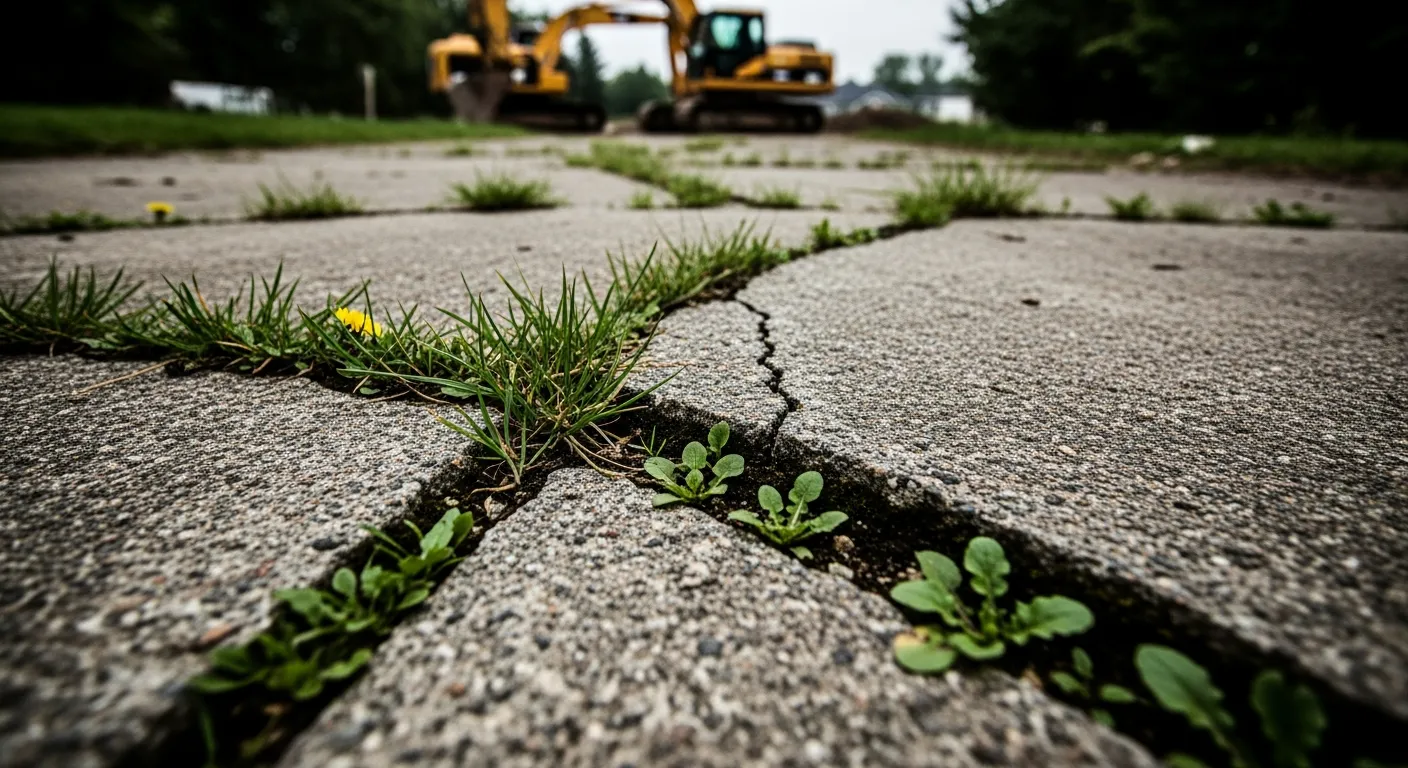
A cracked driveway feels like the concrete let you down. Usually, it didn’t. The vast majority of driveway cracks and settling trace back to what’s under the slab — the base that was supposed to support it evenly and didn’t.
That’s actually good news. It means cracking is largely preventable, and the prevention happens before a single bag of concrete shows up. Here’s what really causes driveways to fail in Southwest Michigan, and how proper prep heads it off.
Concrete doesn’t crack on its own
Concrete is incredibly strong when it’s evenly supported. It carries vehicles, trailers, and decades of weather without complaint — as long as the ground beneath it stays put and stays even.
Cracks appear when that support becomes uneven. A soft pocket forms, one section drops a fraction of an inch, and now the slab has to span the gap. Concrete can’t bend, so it cracks instead. Almost every structural driveway crack is really the ground telling you it moved.
The usual culprits
Organic material left in the subgrade
If topsoil, roots, or other organic matter gets left under the slab, it slowly decomposes and compresses. That creates voids, the slab settles into them, and it cracks. The fix is simple but non-negotiable: strip down to clean, stable subgrade before anything else.
Poor or skipped compaction
Loosely placed soil and gravel keep settling under load. If the subgrade and base aren’t compacted to proper density — in lifts, not all at once — the driveway is sitting on ground that’s still consolidating. Random cracks within a couple of seasons are the result.
A thin or missing gravel base
The crushed-gravel base spreads vehicle loads across the subgrade and gives water a path. Build it too thin or skip it, and loads concentrate on soft spots. Around here, where clay subgrade is common, a properly built base is what stands between your driveway and the soil’s seasonal movement.
Water and Michigan’s freeze-thaw cycle
This is the big one in our climate. Water that collects under a slab freezes, expands, and lifts the concrete — then thaws and drops it. Repeat that dozens of times each winter and even a decent slab heaves and cracks. Driveways that aren’t graded to drain are signing up for it.
Tree roots and buried surprises
Roots growing under a slab and old buried debris both create uneven pressure over time. Good removal and prep gets these out of the equation before the pour.
How proper prep prevents all of it
Every failure above has the same answer: build a base that’s clean, dense, thick enough, and draining. Done right, site preparation means:
- Stripping organics down to stable subgrade so nothing decomposes underneath.
- Compacting in lifts so the ground stops settling before the concrete goes down.
- Building an adequate gravel base — generally four to six inches, more for weak soils — to spread load.
- Grading to drain, sloping away from the house so water never gets trapped under the slab to freeze.
That’s it. No magic, no premium additive — just earthwork done in the right order. The driveways that last decades aren’t poured from special concrete. They’re poured on a base that doesn’t move.
Replacing a cracked driveway? Fix the base too
Here’s the mistake we see most: a homeowner tears out a cracked driveway, pours fresh concrete on the same base, and is surprised when it cracks again on roughly the same schedule. The concrete was never the problem. If the base that failed the first slab is still there, it’ll fail the second one too.
When we remove and replace a driveway, correcting the base is the whole point. Otherwise you’ve spent good money to repeat a mistake.
Frequently asked questions
Are all driveway cracks a base problem?
Not every hairline. Concrete shrinks slightly as it cures, and minor surface cracks happen. But the cracks that matter — the ones that widen, settle, and break the slab apart — are overwhelmingly base and drainage failures.
Can you save my existing driveway?
It depends on the cause. Sometimes drainage corrections help. But a slab that’s settling because of a failed base usually needs replacement with the base done right — and we’ll tell you honestly which situation you’re in.
Does freeze-thaw really matter that much here?
In Southwest Michigan, yes. We cross the freezing point repeatedly all winter. Water under a slab that freezes and thaws over and over is one of the most common reasons driveways heave and crack in our region.
How do I make my next driveway last?
Insist on the prep. Ask how the base will be built, how it’ll be compacted, and how it’ll drain. A contractor who can answer those clearly is the one whose driveway is still flat in ten years.
Pour your next driveway on a base that lasts
If your driveway cracked too soon, the slab probably wasn’t the problem — and pouring another one on the same ground won’t fix it. Tell us about your driveway or call (269) 230-1777, and we’ll build a base your concrete can count on.